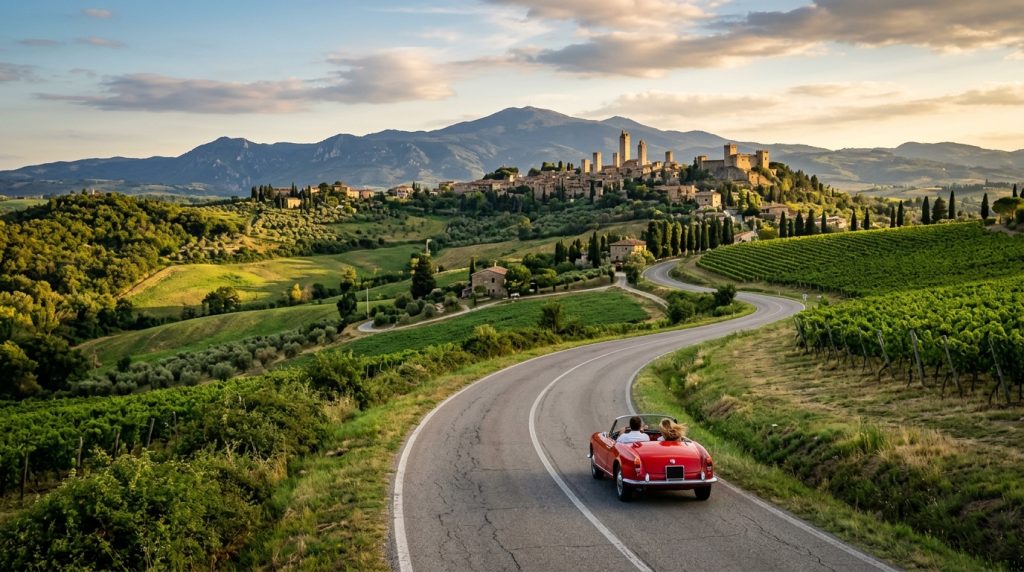

There’s a moment on almost every European road trip when the highway narrows into a two-lane country road, the GPS voice goes quiet for a while, and suddenly you’re driving past a vineyard, a castle on a hill, or a lake so still it looks painted. That moment is usually why people plan the trip in the first place, and it’s also the moment no guidebook photo quite captures.
For American travelers used to road-tripping across wide interstates, a European road trip feels different in the best way. The distances are shorter, the scenery changes faster, and you can have breakfast in one country and dinner in another without ever setting foot on a plane. It’s slower travel in the sense that matters and faster in every other way.
This guide walks through the best routes, when to go, what it actually costs, and the driving rules that trip up most first-time visitors from the US.
Why Choose a European Road Trip?
The appeal isn’t just the postcard scenery, though there’s plenty of that. It’s the freedom to stop wherever looks interesting. A bus tour won’t pull over because you spotted a bakery with a line out the door, but your own car will.
Road trips also open up the parts of Europe that package tours skip entirely: the small mountain villages, the roadside vineyards, the towns too small to have a train station. You get local culture without a schedule attached to it, and landscapes that shift from coastline to alpine pass to olive grove within a single day’s drive.
Read more trevellaura
Best European Road Trip Routes
Romantic Road, Germany
This classic route runs roughly 220 miles between Würzburg and Füssen, threading through medieval towns like Rothenburg ob der Tauber. Plan on 5 to 7 days if you want time to actually wander the town squares instead of just photographing them. Late spring and early fall bring good weather and fewer coach tours crowding the cobblestones.
Tuscany, Italy
Tuscany rewards travelers who slow down. A week gives you enough time to base yourself in Siena or Florence and take day loops through the Val d’Orcia’s cypress-lined hills, Chianti’s vineyards, and hilltop towns like San Gimignano. September and October hit the sweet spot: harvest season, warm days, and cooler nights.
Amalfi Coast, Italy
The Amalfi Coast is stunning and, frankly, a little stressful to drive. The cliffside roads are narrow, and summer traffic can turn a 40-minute drive into two hours. Three to four days is usually enough to hit Positano, Ravello, and Amalfi town itself. Go in late spring or early fall if you want the views without the July gridlock.
Switzerland Alpine Route
Winding through the Bernese Oberland and over passes like the Grimsel and Furka, this route is where Europe road trip photos come from. Five to six days lets you take it slowly, with stops for cable cars and lakeside towns like Interlaken. Summer (June through August) is when the high mountain passes are guaranteed to be open.
Portugal Coastal Road
The drive from Lisbon down through the Alentejo coast to the Algarve is less crowded than Spain’s coastline and arguably just as beautiful. Give it 6 to 8 days to include surf towns, seafood dinners, and dramatic cliffs near Sagres. Spring and early fall avoid both the heat and the summer tourist surge.
Iceland Ring Road
Technically a European road trip, though it feels like another planet. The full Ring Road is about 830 miles and takes 7 to 10 days to do justice, with waterfalls, black sand beaches, and glacier views along the way. Summer offers nearly 24-hour daylight, which is either a dream or slightly disorienting depending on how you sleep.
Slovenia Lake Bled Route
Often overlooked, this is one of the best-value routes in Europe. Four to five days covers Lake Bled, the Julian Alps, and Ljubljana’s old town, all without the crowds of nearby Italy or Austria. Late spring through early fall is ideal, with the lake at its clearest in summer.
Best Time for a European Road Trip
Spring (April–May): Mild weather and blooming landscapes, though mountain passes in the Alps may still be closed.
Summer (June–August): Long daylight hours and full access to alpine routes, but also peak crowds and the highest prices.
Fall (September–October): Many road trippers’ favorite season. Harvest in wine regions, thinner crowds, and comfortable temperatures.
Winter (November–March): Dramatically fewer tourists and lower prices, but shorter days and some routes (especially mountain passes) partially closed.
European Road Trip Cost Guide for USA Travelers
Costs vary a lot by country, but here’s a realistic range for a two-week European road trip trip:
- Flights from the US: $600–$1,200 round trip, depending on season and city
- Rental car: $35–$70 per day, more for automatic transmission
- Fuel: $6–$8 per gallon equivalent in most of Western Europe
- Accommodation: $80–$180 per night for mid-range hotels or guesthouses
- Food: $40–$70 per day for a mix of casual meals and one nicer dinner
- Tolls: $10–$40 per day in countries like France and Italy; free in Germany
- Parking: $10–$25 per day in cities, often free in small towns
A two-week trip for two people typically lands somewhere between $3,000 and $5,500, not including flights.
Driving Tips for Americans Visiting Europe
- International Driving Permit (IDP): Many countries require or strongly recommend one alongside your US license. Get it from AAA before you leave.
- Manual vs. automatic: Automatic cars are still less common in Europe and often cost more to rent. Reserve early if you don’t drive stick.
- Road signs: European signs rely more on symbols than text, so it’s worth reviewing common ones before you go.
- Toll roads: Italy and France use ticketed toll systems; Germany’s autobahns are largely toll-free for cars but require a vignette in Austria and Switzerland.
- Parking rules: Many old town centers restrict cars entirely (look for ZTL zones in Italy). Always check before you park.
- Country differences: Speed limits, right-of-way rules, and even minimum driving ages vary by country, so don’t assume the rules from Germany apply in Portugal.
How to Plan Your First European Road Trip
- Choose 2–3 countries, not 6. Fewer countries means more time in each and less time driving.
- Build a realistic route. Two to three hours of driving between overnight stops keeps the trip enjoyable rather than exhausting.
- Book transportation early. Flights and rental cars both get more expensive closer to summer.
- Plan accommodation loosely. Book the first few nights, then leave some flexibility for the rest.
- Leave room to wander. Some of the best stops on any European road trip are the ones you didn’t plan.
Common Mistakes to Avoid
- Trying to see too many countries. A rushed itinerary trades depth for a longer list of stamps in your passport.
- Ignoring local driving rules. Fines for ZTL violations or missing a vignette can arrive by mail months later.
- Overpacking the car. Small European rental cars have limited trunk space, especially for two or more travelers.
- Poor route planning. Underestimating drive times, especially on mountain roads, is one of the most common first-timer mistakes.
Frequently Asked Questions
What is the best European road trip for first-time visitors?
The Romantic Road in Germany or Slovenia’s Lake Bled route are both beginner-friendly, with well-marked roads, manageable distances, and fewer driving challenges than mountain or coastal routes.
How many days are enough for a European road trip?
Ten to fourteen days is a comfortable length for most first-time travelers, allowing time to explore 2–3 regions without constant rushing.
Can Americans drive in Europe?
Yes. A valid US driver’s license works in many countries, though an International Driving Permit is required or recommended in several, including Italy and Spain.
How much does a European road trip cost?
A two-week trip for two people typically costs $3,000 to $5,500, not including international flights, depending on the countries and season.
Which European countries are easiest to drive in?
Germany, Austria, and Slovenia are generally considered easy for American drivers, with clear signage, well-maintained roads, and straightforward rules.
You may also like