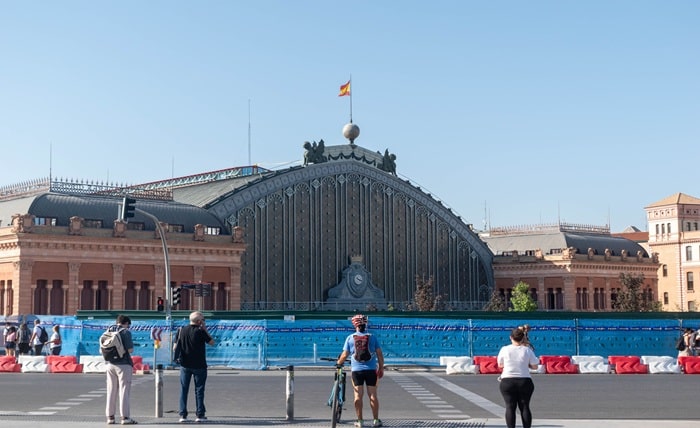
Many trips through Madrid end with a gap: you’ve checked out of your hotel in the morning, but your train from Atocha or your flight from Barajas doesn’t leave until the evening. Those hours can feel like dead time spent in a station café. They don’t have to be. Some of Madrid’s best sights sit within walking distance of Atocha, so a short, well-planned route lets you see a lot of the city and still arrive at the platform relaxed.
Here’s how to make the most of a final day in the Spanish capital.
Why Atocha Is the Perfect Starting Point
Madrid Puerta de Atocha is the city’s main high-speed rail hub, with trains to Barcelona, Seville, Valencia, Málaga and beyond. It is also one of the best-placed stations in Europe for last-minute sightseeing. Head out of the station and you are just a few minutes on foot from the southern end of the Paseo del Prado, the edge of Retiro Park and the streets of the Literary Quarter.
If you’re flying out instead, Atocha still works well as a base. The Cercanías commuter train connects the station with Barajas Airport’s Terminal 4, so you can spend the day in the centre and travel straight to your flight.
Paseo del Prado: Art on a Single Boulevard
The Paseo del Prado is one of the grandest avenues in Madrid, and together with Retiro Park it is recognised as a UNESCO World Heritage Site. Lined with trees, fountains and some of the most important museums in the world, it’s an easy walk north from Atocha.
Three major museums cluster along this stretch, often called the Golden Triangle of Art:
- Museo del Prado – home to masterpieces by Velázquez, Goya, El Greco and Bosch. If time is short, focus on Velázquez’s Las Meninas and Goya’s Black Paintings.
- Museo Reina Sofía – just across from Atocha, famous for Picasso’s Guernica and a strong collection of 20th-century Spanish art.
- Museo Thyssen-Bornemisza – a broad collection running from the Old Masters to Impressionism and Pop Art.
You won’t manage all three in a few hours, so pick one and give it the time it deserves. The Prado offers free entry during the last couple of hours of the day, which can suit travellers whose train leaves later in the evening. Afterwards, stroll past the Neptune and Cibeles fountains, two of the city’s most photographed landmarks.
Retiro Park: Madrid’s Green Escape
Behind the Prado lies the Parque del Buen Retiro, once a royal retreat and now a favourite spot for locals to walk, jog and relax. It’s large, but you can see its highlights in an hour or so.
Start at the Estanque Grande, the large lake overlooked by the monument to Alfonso XII, where you can rent a rowing boat for a gentle half hour on the water. Then make your way to the Palacio de Cristal, a striking glass-and-iron pavilion that often hosts free art installations. The Rosaleda rose garden is worth a detour in spring and early summer, and the shaded paths are a welcome break on hot afternoons.
Retiro is the kind of place where you want to wander without a plan. That’s much easier when you aren’t pulling a suitcase over gravel paths, which brings us to a practical point.
Explore Hands-Free: Store Your Bags First
The biggest obstacle to enjoying a final day in Madrid is usually your luggage. Museums such as the Prado restrict large bags, crowded markets are awkward to navigate with a suitcase, and the cobbled streets of the old centre aren’t kind to wheels.
The simplest solution is to drop your bags before you set off. A service offering Madrid luggage storage lets you book a spot online in a couple of minutes and leave your bags at a partner store close to where you are, whether near Atocha, the centre or your hotel. Your items are covered by included insurance, so you can spend the day exploring without worrying about them. When it’s time to leave, just collect your bags and head to the station or airport.
With your hands free, the rest of the day becomes far more enjoyable.
The Literary Quarter: Streets Full of Stories
Just west of the Paseo del Prado, the Barrio de las Letras (Literary Quarter) is one of Madrid’s most charming neighbourhoods. During Spain’s Golden Age, it was home to some of the country’s greatest writers, including Miguel de Cervantes, Lope de Vega, Quevedo and Góngora.
Today the area keeps that heritage alive in small details. Look down as you walk along Calle de las Huertas and you’ll see quotes from famous works set into the pavement in brass letters. You can visit the Casa Museo de Lope de Vega, the playwright’s preserved home, and pass the Convento de las Trinitarias, where Cervantes is buried.
The neighbourhood is also packed with traditional taverns, bookshops and cafés. Plaza de Santa Ana is a lively square to stop for a drink or a few tapas before continuing your walk.
Madrid’s Markets: A Taste of the City
No visit to Madrid is complete without sampling its food, and the city’s markets are the best place to do it in a short time.
- Mercado de Antón Martín – a short walk from Atocha and the Literary Quarter, this local market mixes traditional produce stalls with small bars serving everything from Spanish classics to international dishes.
- Mercado de San Miguel – near Plaza Mayor, this elegant iron-framed market is the most famous in the city. It’s busy, but ideal for trying croquetas, jamón, oysters and vermouth in one stop.
- Mercado de San Fernando – in the multicultural Lavapiés district, a relaxed, local favourite with affordable food and a friendly atmosphere.
Markets are also a smart way to pick up snacks or picnic supplies for your train journey.
A Sample Itinerary for Your Last Hours
If you have around six to eight hours, here’s an easy route:
- Morning: Store your bags, then visit the Reina Sofía or the Prado.
- Late morning: Walk up the Paseo del Prado to the Cibeles fountain.
- Midday: Enter Retiro Park, see the lake and the Palacio de Cristal.
- Lunch: Head into the Literary Quarter for tapas around Plaza de Santa Ana.
- Afternoon: Explore Calle de las Huertas, then browse the Mercado de Antón Martín.
- Evening: Collect your bags and walk back to Atocha for your train, or take the Cercanías to the airport.
Leave a comfortable buffer before departure, as high-speed trains require security screening and boarding gates close shortly before departure.
Make Your Final Day Count
A few spare hours in Madrid can easily become one of the highlights of your trip. With world-class art, a beautiful historic park, literary streets and lively markets all clustered near Atocha, the city rewards travellers who step out of the station and explore. Leave your luggage behind, follow a simple route, and you’ll board your train with great memories rather than sore arms.